There are thousands of variations of setting styles, but there are several fundamental types:
Bezel setting
The earliest technique of attaching stones to jewellry was bezel setting. A bezel is a strip of metal bent into the shape and size of the stone and then soldered to the piece of jewellry. Then the stone is inserted into the bezel and the metal rubbed over the stone, holding it in place. This method works well for either cabochon or faceted stones.
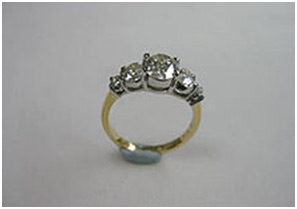
Prong set diamonds
Prong setting
Prong setting is the simplest and most common type of setting, largely because it uses the least amount of metal to hold the stone, thus showing it off to its best advantage. Generally it is simply some number of wires, called prongs, which are of a certain size and shape, arranged in a shape and size to hold the given stone, and fixed at the base. Then a burr of the proper size, is used to cut what is known as a "bearing", which is a notch that corresponds to the angles of the stone. The burr most often used is called a "hart bur" that is angled and sized for the job of setting diamonds. That bearing is cut equally into all of the prongs and at the same height above the base. Then the stone is inserted so that it goes into all of the bearings, pliers or a pusher are used to bend the prongs gently over the crown of the stone, and the tops of the prongs are clipped off with snips, filed to an even height above the stone, and finished. Usually a "cup burr" is used to give the prong a nice round tip. A cup burr is in the shape of a hemisphere with teeth on the inside, for making rounded tips on wires and prongs. There are as many variations of prong settings as there are stars in the sky - 2 prongs up to 24 or more, many variations involving decoration, size and shapes of the prongs themselves, and how they are fixed or used in jewelry. But the method of setting is generally the same for all of them.

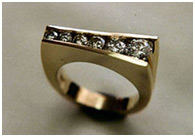
Channel set diamonds
Channel setting
Channel setting is a method whereby stones are suspended between two bars or strips of metal, called channels. Often when setting small stones and the bars go in a linear line with the design it is called channel setting, and when the bars cross the lines of the design, it's called bar set. The idea is the same, though. The channel is some variation of a "U" shape, with two sides and a bottom. The sides are made just a bit narrower than the width of the stone or stones to be set, and then, using the same burs as in prong setting, a small notch, which is again called a bearing, is cut into each wall. The stone is put in place in those notches, and the metal on top is pushed down, tightening the stone in place. The proper way to set a channel is to cut a notch for each stone, but for cheaper production work sometimes a groove is cut along each channel. Also, since the metal can be very stiff and strong, this is a situation where a reciprocating hammer, which is like a jackhammer but jewellery sized, might be used to hammer down the metal, as it can be difficult to do by hand. Then, as always, the metal is filed down and finished, and the inner edge near the stones cleaned up and straightened as necessary. As with all jewellery, there can be many variations of channel work. At times the walls will be raised - sometimes a center stone will be set between two bars that rise high from the base ring - or the channel might just be cut directly into some surface, making the stones flush with the metal. It is still channel setting, though.
Example of bead set diamonds
Bead setting
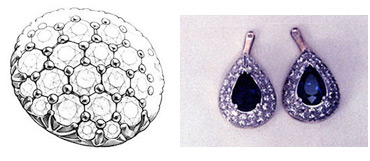
Bead setting is a generic term for setting a stone directly into metal using gravers, also called burins, which are essentially tiny chisels. A hole is drilled directly into the metal surface, and then a ball burr is used to make a concave depression just the size of the stone. Some setters will set the stone into that concave depression, and some will use a hart burr to cut a bearing around the edge. Then the stone is inserted into that space, and the gravers or burins are used to lift and push a tiny bit of the metal into and over the edge of the stone. Then a beading tool, which is simply a steel shaft with a concave dimple cut into the tip, is pushed onto the bit of metal, rounding and smoothing it, pushing it firmly onto the stone, and creating a "bead". That is the essential method, but there are many types of setting that use the technique. When many stones are set in this fashion very closely together, covering a surface, that is called "pav�" - from the French for paved or cobblestoned. When a long line is engraved into the metal going up to each of the beads, that is "star set", because of the look. The other common usage is called "bead and bright", "grain setting" or "threading" in Europe, and other names at times. This is when, after the stone is set as described above, the background metal around the stone is cut away, usually in geometric shapes. In the end what is left is the stone with four beads in a lowered box shape with an edge around it. Often it is a row of stones, so it will be in a long shape with a raised edge and a row of stones and beads down the center. This type of setting is still used often, but it was very common in the early to middle 20th century.
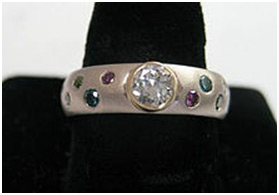
Burnish set diamonds
Burnish setting
Burnish setting or flush setting is similar to bead setting, but after the stone is inserted into the space, instead of using a graver to lift beads, a rubbing tool is used to push the metal all around onto the stone, not very different from bezel setting. The stone will be roughly flush with the surface, with a nice rubbed edge around it. This is a fairly recent type of setting, looks very contemporary, and the metal is often finished using sandblasting, as it shows off the work very well.
Pave setting
A pave or pav� (pronounced pah-vay) setting is a stone setting in which multiple small stones are set close together and very close to the surface of a piece of jewelry, making it look like the jewelry has been paved in gemstones. One classic use of the pave setting is in diamond jewelry, where multiple small diamonds can shine with brilliance in a pave setting. This type of setting is especially popular for rings and pendants.
Invisible setting
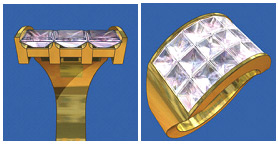
For this project, it is assumed that you have prepared the mounting and acquired the grooved stones for invisible setting. The use of a microscope or 10x eye loupe can be crucial when working with the tight tolerances involved in the invisible setting process.