


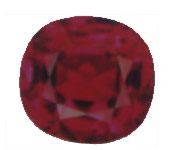
Composition - Aluminium oxide ; Hardness - 9
Ruby – the name given to red, gem – quality corundum is one of the best gemstones for jewellery settings. Rubies may be any shade of red, from pinkish to purplish or brownish red, depending on the chromium and iron content of the stone. Frequent twinning of the crystals make the material liable to fracture, yet ruby is a tough mineral, second only to diamond in hardness. Crystal prisms are hexagonal with tapering or flat ends. As the crystal grow they form new layers, and depending on the geological conditions and minerals present, colour variations, called zoning, occur.
OCCURRENCE
Worldwide in igneous and metamorphic rocks, or as waterworn pebbles in alluvial deposits. The finest stones come from Burma; those from Thailand, the main source, are brownish red; Afghanistan, Pakistan and Vietnam produce bright red stones; those from India, North Carolina (USA), Russia, Australia and Norway are dark, sometimes even opaque.
REMARK
In 1902, a Frenchman, Auguste Verneuil, produced a synthetic ruby crystal by exposing powdered aluminium oxide and colouring material to the flame of a blowtorch.


