Composition - Carbon ; Hardness - 10
Diamond is the hardest mineral on earth, and this, combined with its exceptional lustre and brilliant fire , has made it the most highly prized of all gems. Pure, colourless diamond is the most popular, but other varieties - from yellow and brown to green, blue, pink, red, grey, black � are also found, depending on the impurities present. Because of the uniform arrangement of their constituent carbon atoms, diamond crystals are well-formed � usually octahedral with rounded edges and slightly convex faces. Their perfect cleavage facilitates the early stages of fashioning , but they can only be polished by other diamonds.
OCCURRENCE
Diamond forms at high temperatures and pressure 80km (50 miles) or more underground . When India and later Brazil were the main producers, most diamond came from secondary sources, such as river gravels. However, since the discovery of diamond in Kimberlite rock in South Africa (around 1870), its extraction has involved processing vast quantities of rock. Australia is the main producer today; other localities include Ghana, Sierra Leone, Zaire, Botswana, Namibia, the former USSR, the USA and Brazil.
REMARK
Diamonds are graded by colour, cut, clarity and carat (weight) – four c’s
1) How do I know if a diamond is genuine?
You will not. You need to be an expert and use specialised equipment to make sure a diamond is real. Do not trust ideas like scratching a beer bottle (it may damage the diamond too), thermal conductivity, looking through, comparing weight, etc. If the diamond is accompanied by a certificate, you will know it is real and if it is treated artificially or not.
2) What is the structure of a diamond?
a. Facet: any of the flat "sides" of the diamond.
b. Table: On a brilliant cut stone...the top octagonal facet
c. Girdle: The typically frosty white ring at the widest part.
d. Culet: The bottom point (actually a facet) on a brilliant cut stone
e. Pavilion: The portion of the stone below the girdle
f. Crown: The portion of the stone above the girdle
g. Diameter: Width of the diamond as measured thru the girdle
h. Fire: The quality of the diamond that breaks reflected light into a colourful array.
i. Depth – Height of Gemstone from Culet to Table
j. Brilliance: The quality of the diamond that reflects light without changing it
(also called sparkle).
k. Fluorescence: The characteristic of some diamonds to fluoresce certain colours under some light.
l. Natural: Usually found on the girdle. A small section was on the side of the raw diamond. It appears as a slightly rough flat spot on the girdle.
m. Feather: A “crack” in a diamond, appears as a white feather within the stone.
3) What are the "four C's" relating to diamond quality?
The four C's are Carat (weight), Colour, Clarity and Cut of the stone.
a) Carat: The weight of the stone, referred to in points in case of small stones.
1 carat is 1/5 of a gram or 200 milligrams.
There are 100 points to a carat.
A 75 point stone is .75 carat.
"Carats" represent the weight and not the physical size of the stone.Example, 1 carat diamond is physically larger than a 1 carat ruby since ruby is denser than diamond.

b) Colour: Colour is usually undesirable in diamonds. Typically ratings will be alphabetical with the earlier letters of the alphabet having less colour.
AGS has a similar 0-10 scale.
D, E and F - "Colourless"
G, H, I & J - "near colourless"
K, L and M - faint yellow or "top silver"
N to Z - very light or “light yellow”
Z+ - grades are considered "fancy yellow"
Most stones you will find will be in the E-F to the J-K range.

c) Clarity: You will typically find ratings such as this:
| GIA | AGS |
CLARITY |
| FL | 0 |
Flawless |
| IF | 1 |
Internally Flawless |
| VVS1 | 1 |
Very, Very slightly included |
| VVS2 | 2 |
VVS1 to a less perfect degree |
| VS1 | 3 |
Very slightly included |
| VS2 | 4 |
VS1 to a less perfect degree |
| SI1 | 5 |
Slightly included |
| SI2 | 6 |
SI1 to a less perfect degree |
| I1 | 7-8 |
Included |
| I2 | 8-9 |
I1 to a less perfect degree |
| I3 | 9-10 |
Severely Included |
Inclusions are imperfections within the stone. Inclusions range from bits of
carbon (black spots) to slight cracks (called "feathers") within the stone.
VVS1 to SI2 represent inclusions that are not visible to the naked eye.

d) Cut: All diamonds are cut. The resultant dimensions of the cut stones vary. All dimensions are given as a percentage of the width at the girdle. There are a few accepted ideal cuts, which have all of the proportions within a few percentage points of an optimum mathematical model. This optimum model returns maximum light through the top of the stone, resulting in maximum brilliance.
4) What is a Cubic Zirconia?
Cubic Zirconia stones are a man-made diamond simulants with optical characteristics very close to natural diamonds. On the mohs scale of 1-10 for hardness, a CZ is 8.5 - 8.9, while a diamond is 10. Sand or dirt will not scratch a CZ or a diamond, but CZs and diamonds will both scratch glass. A CZ weighs more than a diamond, and this is a principal way to tell them apart.
5) What are "synthetic" diamonds?
Real diamonds have been created naturally through intense levels of heat and pressure deep within the ground. All natural diamonds are thought to be between 70 million and 3 billion years old. They are mined, cut and polished by highly skilled craftsmen, and are not otherwise tampered with. Synthetic or 'cultured' diamonds are created in the laboratory. All synthetic or 'cultured' diamonds must legally be declared as such.
6) What are the Shapes of the diamonds?
a) Round Brilliant Diamonds

b) Princess Cut Diamond

c) Emerald Cut Diamond

d) Asscher Diamonds

e) Marquise Diamonds

f) Oval Diamonds

g) Radiant Cut Diamonds

h) Pear Shaped Diamonds

i) Heart Shaped Diamonds

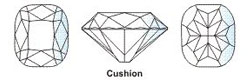
j) Cushion Shaped Diamonds